
MARITIME CYBERSECURITY SERVICES
Comprehensive Maritime Cybersecurity Services | WMS
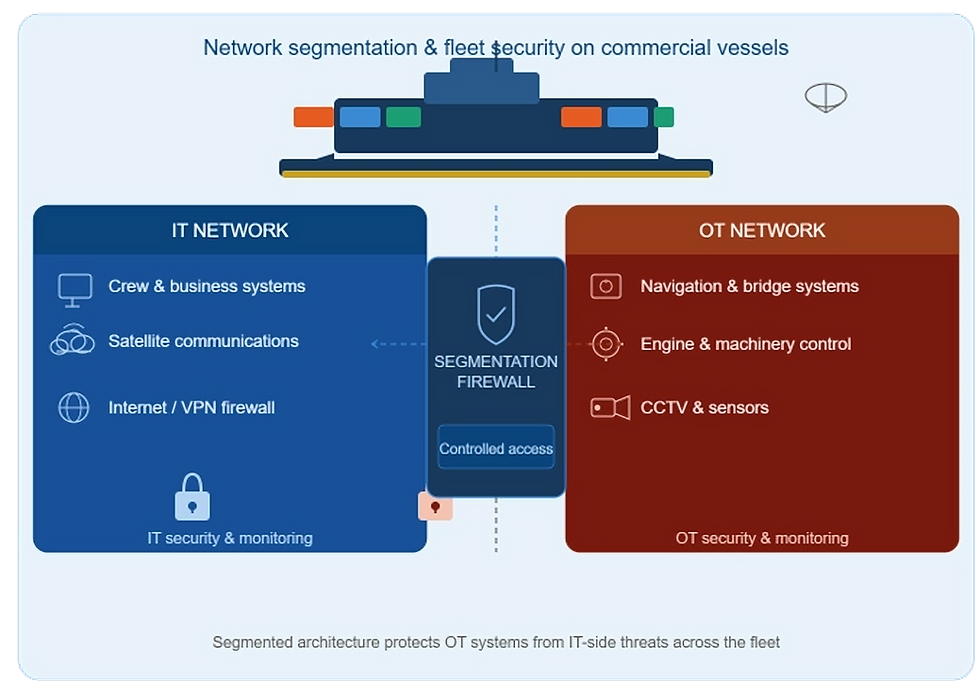
Network Segmentation & Fleet Security Architecture
The majority of vulnerabilities to cyber attacks on commercial ships are not complex; rather, it is simply that shipboard networks are unsegmented.
This means that crew welfare systems, navigation systems (radar, chart plotters), cargo management systems, and engine monitoring systems all operate off of the same shared backbone. Therefore if a single system has been compromised, the attack can then spread through the entire network without being able to be stopped.
We do this so that while these separate segments will have no impact on the day-to-day functioning of the vessel, in the event of a cybersecurity incident the potential damage will be contained within its designated segment.
In addition to evaluating each individual vessel's network configurations, we also perform fleet-wide cybersecurity assessments. These enable us to develop a standard level of risk acceptance across multiple ships.
Cyber Risk Assessments & Vulnerability Audits
A structured risk assessment identifies what you have and how it is connected to identify the realistic attack pathways before someone else finds them.
Assessments are conducted using IMO and IACS frameworks which will provide a clear risk register and prioritise a remediation programme that is proportionate to the actual threat profile of your vessel.
Cyber risk in commercial shipping is no longer an emerging issue — it has become a part of maritime operations and increasingly a regulatory
Our process begins by assessing the current configuration of onboard networking, identifying areas where vulnerabilities exist, and developing segmented architectures for the operationally important elements of the systems we've identified as needing to be separated from lower-risk systems.
Furthermore, since our audits evaluate risks at the fleet-level, they allow us to identify systemic vulnerabilities before those vulnerabilities create incidents.
Regulatory Compliance — IACS UR E26/E27 & IMO MSC-FAL.1
Classification Societies are enforcing compliance with these regulations. Port State Authorities are becoming increasingly aware of this regulation.
We assist operators in identifying exactly what they need to comply with regarding their specific fleets.
We map the operator's existing fleet operational conditions to the IACS guidelines. Finally, we help operators create a compliance plan that meets the requirements, and we organise, document, and make it defensible.

The regulatory environment for ship owners has clearly shifted.
IACS Unified Requirements for Cyber Security and Safety of Navigation (E26 and E27), which have been in place since July 2024 for all new contracts, mandate a baseline level of cybersecurity for the entire vessel (E26) and for each computer-based system or device on board (E27).
IMO Resolution MSC-FAL.1/Circ. 3, which has undergone three revisions to date, provides the broad framework for managing cyber risk across the global merchant marine fleet. This framework also includes vessels currently in operation.
Meeting these compliance obligations will be difficult. These requirements include the need to ensure that the design of the vessel meets the needs outlined by the regulations; how networks should be configured within the vessel; how OT/IT interfaces can be implemented effectively; how an inventory of assets can be created and managed; and finally, how operators can document responses to incidents.
Cyber risk in commercial shipping is no longer an emerging issue — it has become a part of maritime operations and increasingly a regulatory requirement. Maritime cyber incidents have more than doubled in 2025, and as of summer of 2025 there are new mandatory compliance requirements for all vessels contracted after that time period.
Therefore, most operators are focused on the question of how quickly they can close gaps instead of whether or not to act.